01BioEmu
Target dynamics
AI-estimated conformational ensembles of protein targets, cryptic pockets and druggability per state.
AI Research · Solution Architecture · Computational Chemistry
I architect AI systems that compress the path from protein target to drug candidate — from conformational dynamics and core hopping to ADMET and formulation.
Research focus
My work sits at the intersection of machine learning, structural biology and software architecture. I design end-to-end platforms where generative models, physics-based docking and trained ADMET predictors work as one coherent, auditable system.
A central theme is computational core hopping: replacing a molecule's scaffold while preserving the interactions that make it active — opening new chemical space, improving safety profiles and creating freedom to operate.
Flagship platform
A multi-agent AI drug discovery workspace I designed and built — bilingual (EN/FR), mission-driven, from target to pre-formulation.
AI-estimated conformational ensembles of protein targets, cryptic pockets and druggability per state.
Target-aware generative chemistry producing candidate ligands conditioned on the binding site.
Scaffold replacement that preserves pharmacophore geometry while escaping crowded IP and liability-bearing cores.
Pose prediction and interaction analysis with an interactive structural viewer.
22 ADMET endpoints, physico-chemical rules, applicability domain and a pre-formulation engine (BCS, ESOL).
Missions run by cooperating AI agents that plan, execute and document each discovery step.
Inside the platform
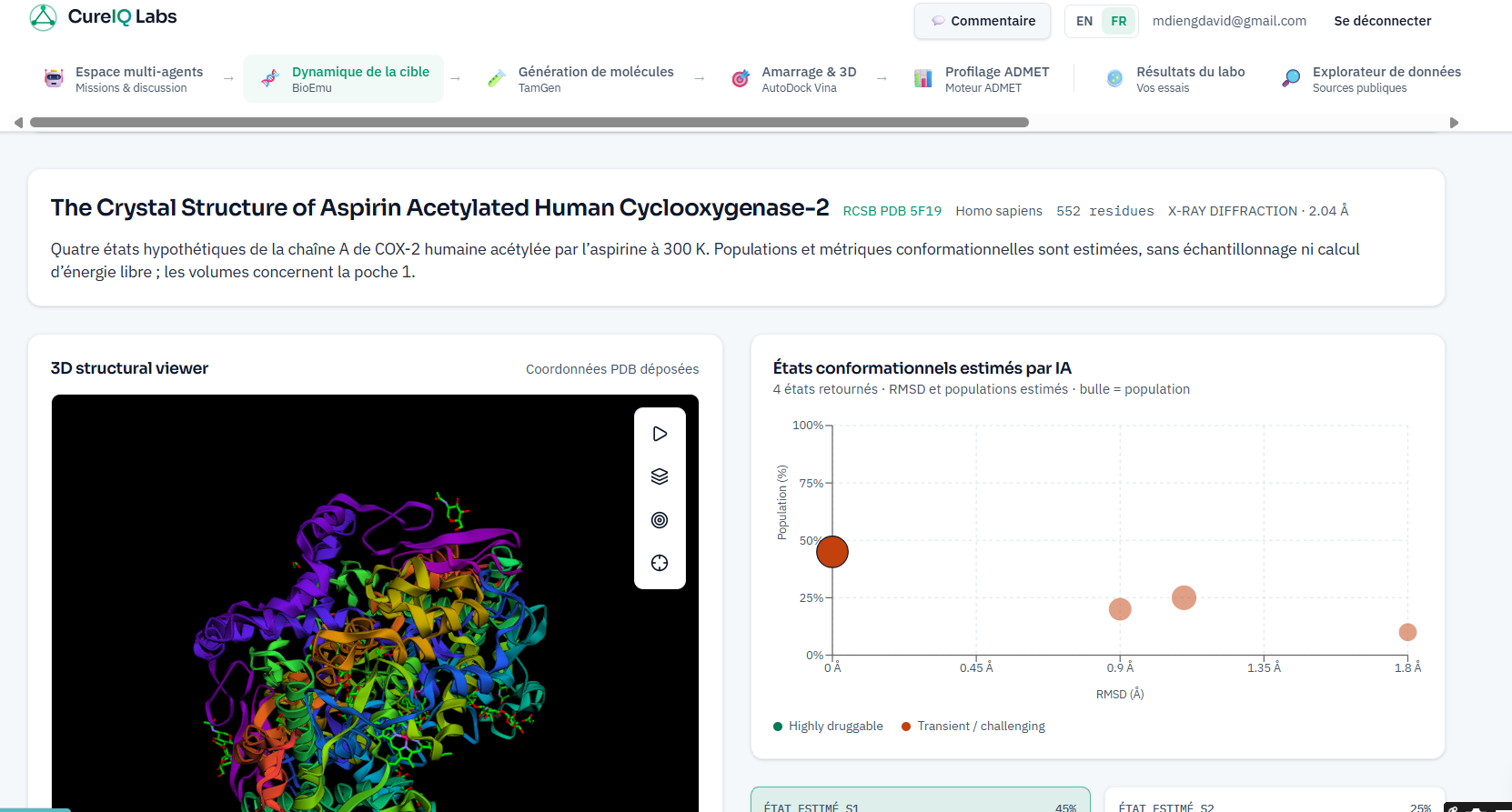
AI-estimated conformational states of aspirin-acetylated COX-2 (PDB 5F19) with a 3D structural viewer.
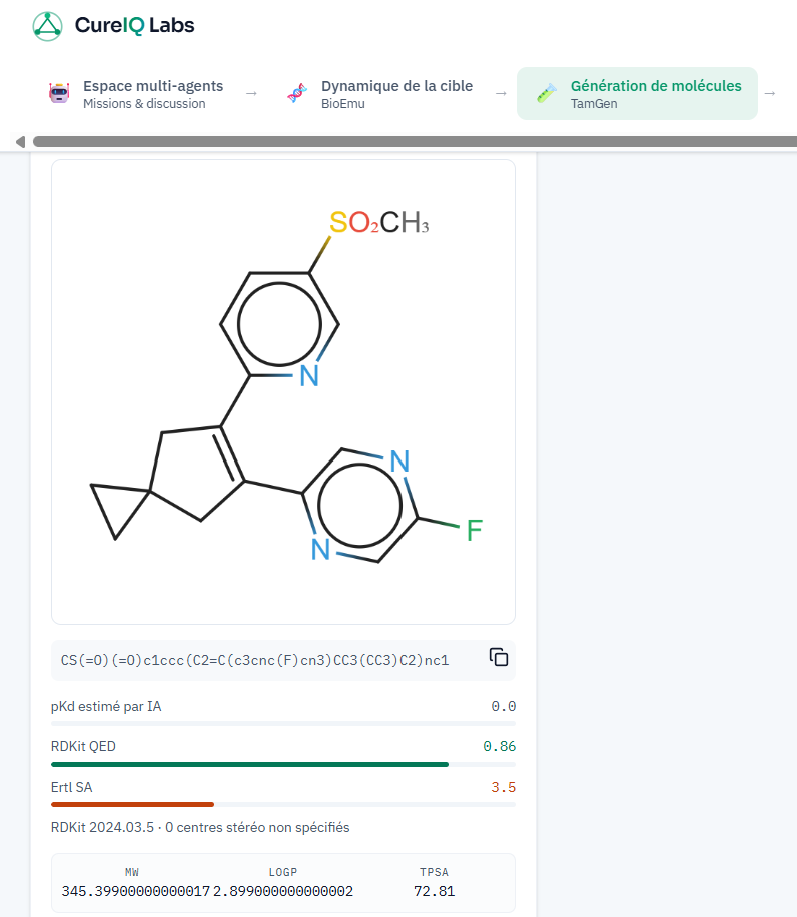
Generated candidate with SMILES, QED, synthetic accessibility and physico-chemical descriptors.
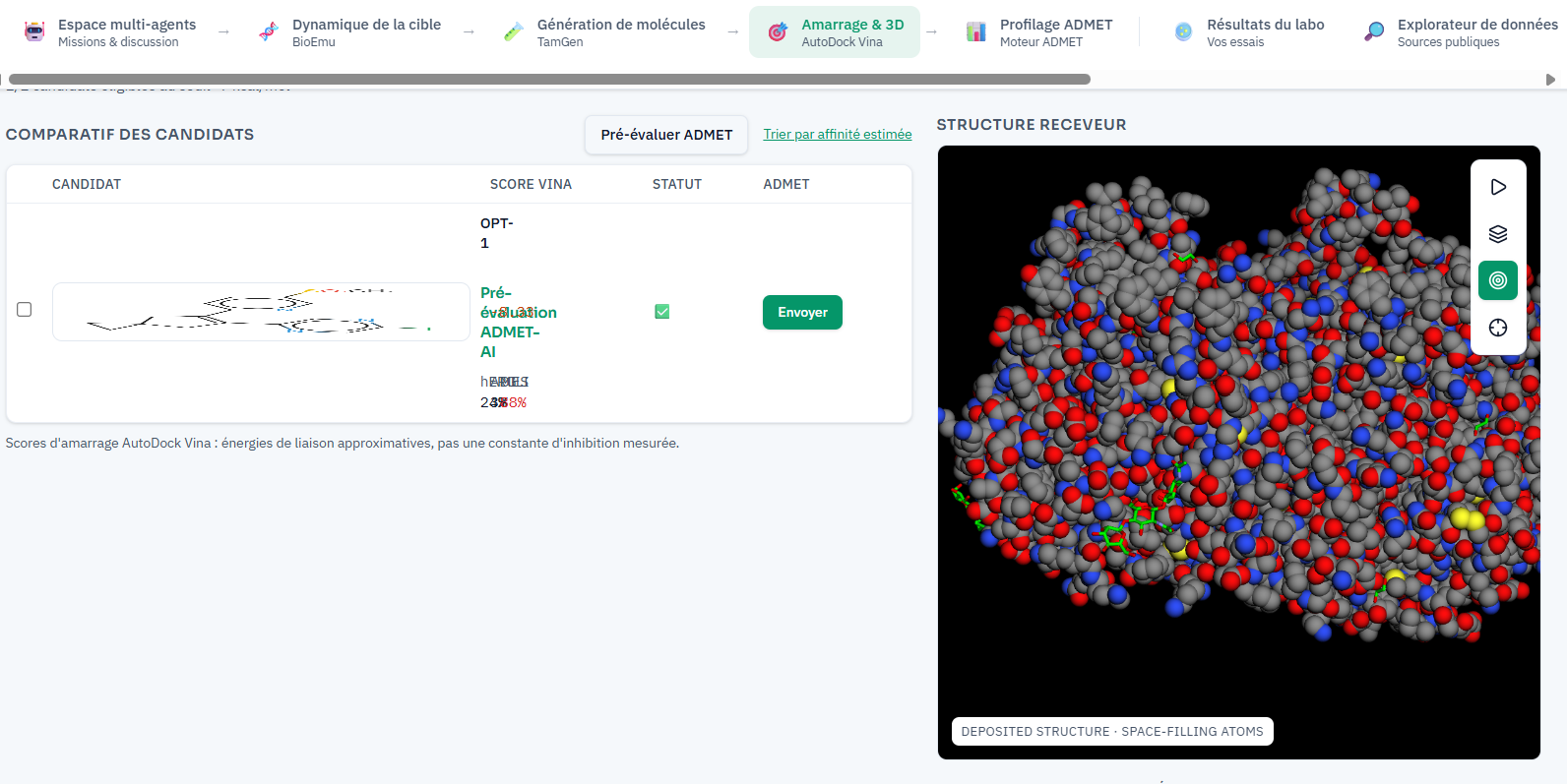
Candidate comparison with Vina scores, ADMET pre-evaluation and space-filling receptor view.
Method
Every model is benchmarked against reference drugs — hERG, DILI, Ames, clinical toxicity — and its reliability is shown, not hidden.
Predictions declare when a molecule is out of the model's applicability domain, and convert uncertainty into concrete validation assays.
Reproducible sessions, versioned runs, cached results, CSV and PDF decision dossiers that a medicinal chemist can defend.